Most ASEAN enterprises already have working AI pilots. What separates the ones that reach governed production isn't a better model — it's an operating model.
With perspective from Ngô Mạnh Hà, CEO, TechX
Enterprise AI in 2026 is not a model problem. It's an operations problem.
The hard part was never getting a model to perform well in a demo. Model quality has become commoditized faster than almost anyone predicted. The hard part is running that model in production — under regulation, at scale, with someone accountable for every decision made with it.
Most ASEAN enterprises are closer to this inflection point than they think. They have working pilots. What they don't have, in most cases, is the operating model to move those pilots into governed production.
Three things “AI-ready” actually requires
“AI-ready” has become a phrase every enterprise uses and few can defend under scrutiny. In practice, for a regulated enterprise, it requires three specific things — and none of them is the model itself.
A trusted data foundation. GenAI fails quietly when enterprise data isn't governed — not because the model is wrong, but because the boundaries around what it can see and use were never defined clearly enough to defend.
Human-in-the-loop governance. AI can reason and recommend at a scale no team can match manually. Action is different: in a regulated environment, action needs an approval flow and a human who is accountable for the outcome — the AI drafts and recommends, it does not decide or execute on its own.
Audit-ready operations. Every signal, recommendation, and decision needs an evidence trail attached to it. “The model did it” is not an answer a regulator, or a board, accepts.
A pilot can succeed without any of these being fully solved. Production can't.
Why this matters most for BFSI and telecom
For banks and telecom operators, this isn't a theoretical governance exercise — it's the difference between an AI system that's an asset and one that's a liability. AI output used without evidence and human review isn't innovative in a regulated industry; it's a finding waiting to be written up. Both sectors are also where the volume and sensitivity of the underlying data raise the cost of getting the data foundation wrong.
That's why the operating model, not the model itself, is the competitive variable in these industries over the next 18 months. The enterprises that win with AI won't be the ones with the most impressive demo. They'll be the ones that can operate what they've built — continuously, defensibly, and at scale, with people accountable for every decision.
The role of a governed operating model
This is the case TechX makes for AI-native managed services, and it's the reason Xora exists as an AI-assisted, human-approved operating platform rather than an autonomous one. Agents monitor signals, reason over evidence, and draft recommendations grounded in a Source-of-Truth catalog, evidence-backed and audit-ready; people remain accountable for every approval and every action that follows.
The model is one layer. The governed operating model is what makes that layer safe to run in a bank or a telecom operator's production environment — and it's the layer most enterprises still need to build.
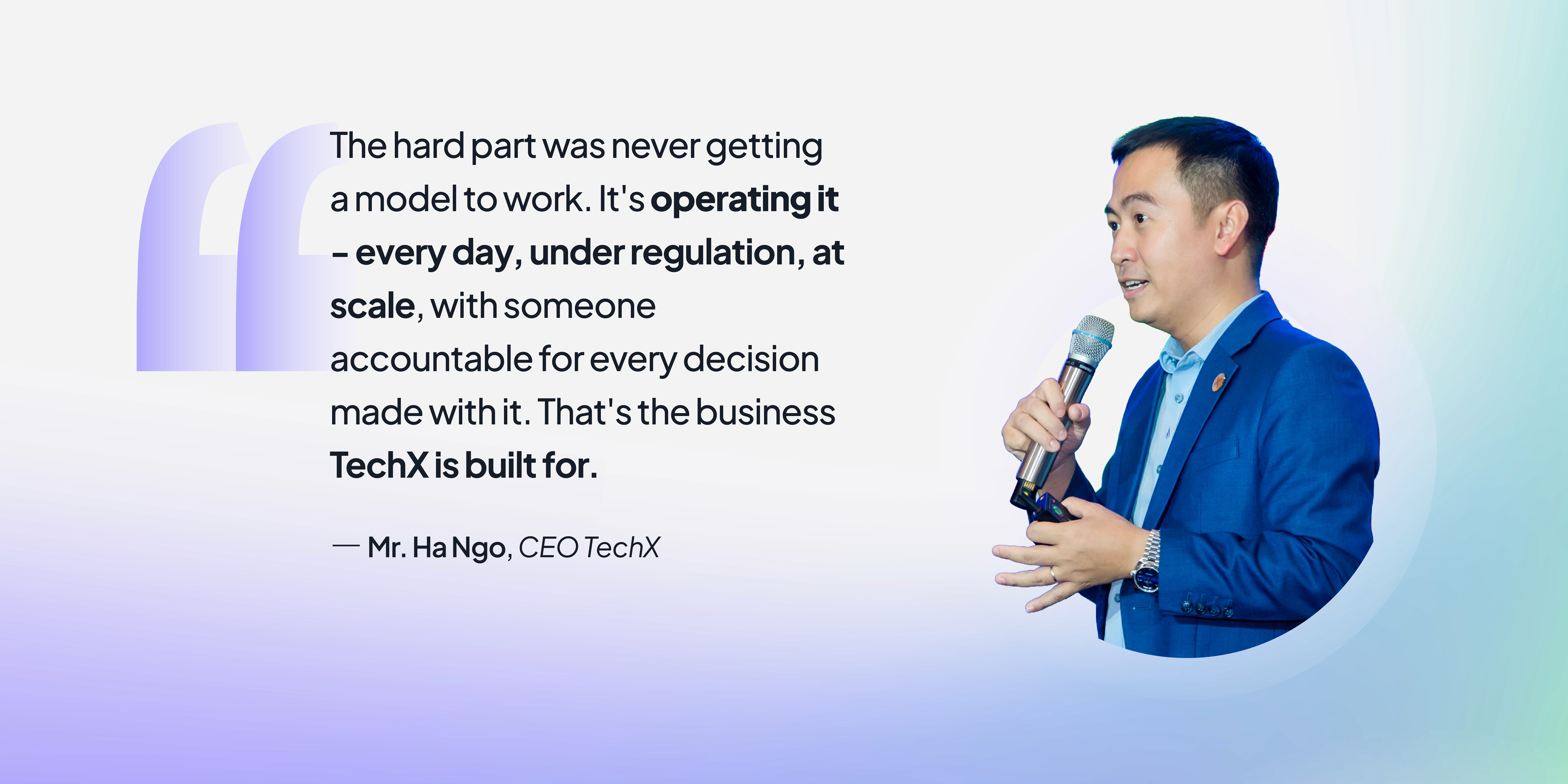
“The hard part was never getting a model to work. It's operating it — every day, under regulation, at scale, with someone accountable for every decision made with it. That's the business TechX is built for.” — Ngô Mạnh Hà, CEO, TechX
Where your organization stands
The honest question for any enterprise evaluating its AI program in 2026 isn't “how good is our model?” It's: are we running pilots, or production? And if it's still pilots, what's actually missing — the model, or the operating model around it?
Xora, TechX's Agentic AI Platform behind this operating model, is listed on AWS Marketplace — evaluating it can start with a scoped private offer inside an AWS relationship already in place.